

Adrift at sea and floating ever closer to an island of plundering cannibals, John G. Paton and Joseph Copeland’s journey nearly ends in disaster. But their arrival in the New Hebrides is only the beginning of their trials as they prepare to establish mission stations on Tanna.
This is the sixth in a series of episodes from the life of John G. Paton, adapted from his autobiography for young readers. Read the first part of the series here.
7 min read
On December 1, 1857, when I was thirty-three years old, Joseph Copeland and I were appointed preachers of the gospel. Then we spent four months visiting and addressing nearly every congregation and Sunday school in the Reformed Presbyterian Church of Scotland so that the people might see us and know us, and take a personal interest in our work. On March 23, 1858, in Dr. Symington’s church in Glasgow, in the presence of a mighty crowd, and after a magnificent sermon on “Come over and help us” (Acts 16:9), we were solemnly ordained as ministers of the gospel and set apart as missionaries to the New Hebrides.
Soon after, I married Mary Ann Robson on April 2. Only two weeks later, on April 16, we all set sail from Greenock in the Clutha for the foreign mission field, not knowing what sore trials lay before us.
Our voyage to Melbourne was tedious, but it ended well. Captain Broadfoot, a kindly, brave-hearted Scot, did everything possible for our comfort. He himself led the singing at worship, which was always charming to me, and worship services were always held regularly—on deck when the weather was pleasant, below when it was rough. And the captain allowed me to conduct Bible classes at times and places designated by him. Years later, on a return trip to Scotland (my second in thirty years), I was greeted by a gentleman who warmly reminded me that he had helped lead worship during my Bible classes on the Clutha. How my heart has treasured those dear and joyful memories, especially in light of the difficulties that soon followed.
When we arrived in Melbourne, Australia, Mary and I went to Geelong, a nearby port city, to visit some dear friends. Joseph remained on board the Clutha to look after our cargo and to seek out any ship that might take us to the islands of the New Hebrides. An American ship, the Francis P. Sage, was sailing from Melbourne to Penang; and the captain agreed to land us on Aneityum, New Hebrides, with our two boats and fifty boxes, for £100. We boarded on August 12, but such a gale blew that we could not set sail till the 17th.
On the Clutha, all had been quiet and orderly; the F. P. Sage was all noise and profanity. The captain said he kept his second mate for the purpose of swearing at the men and knocking them about. We found the voyage unpleasant but short—it lasted only twelve days. On August 29, we were close to Aneityum, but the captain refused to land us, even in his boats. (Some of us suspected that his men were so badly treated that if they had got on shore, they might never have returned to him!) He had already secured his £100; our needs were not his concern.
He lay off the island till a trader’s boat pulled across to see what we wanted, and by it we sent a note to Dr. Geddie, one of the missionaries there. Early next morning, he arrived in his boat, accompanied by Mr. Mathieson, a newly arrived missionary from Nova Scotia. He also brought Captain Anderson in the small mission schooner, the John Knox, and a large mission boat called the Columbia, well manned with crews of able and willing natives. Our fifty boxes were soon on board the John Knox, the Columbia, and our own boats. They were all heavily loaded and built up, except those that had to be used in pulling the others ashore. Several of us, including Mary and I, were perched among the boxes on the John Knox and had to hold on as best we could. But when we sheered off from the F. P. Sage, one of her cranes caught and broke the mainmast of the little John Knox just above the deck. My wife was nearly crushed to death, but I managed to swing her out of the way just in time! It grazed Mr. Mathieson, but he was unhurt. The John Knox, already overloaded, was completely disabled. About ten miles at sea, we were in imminent danger, but the captain of the F. P. Sage heartlessly sailed away, leaving us to struggle with our fate.
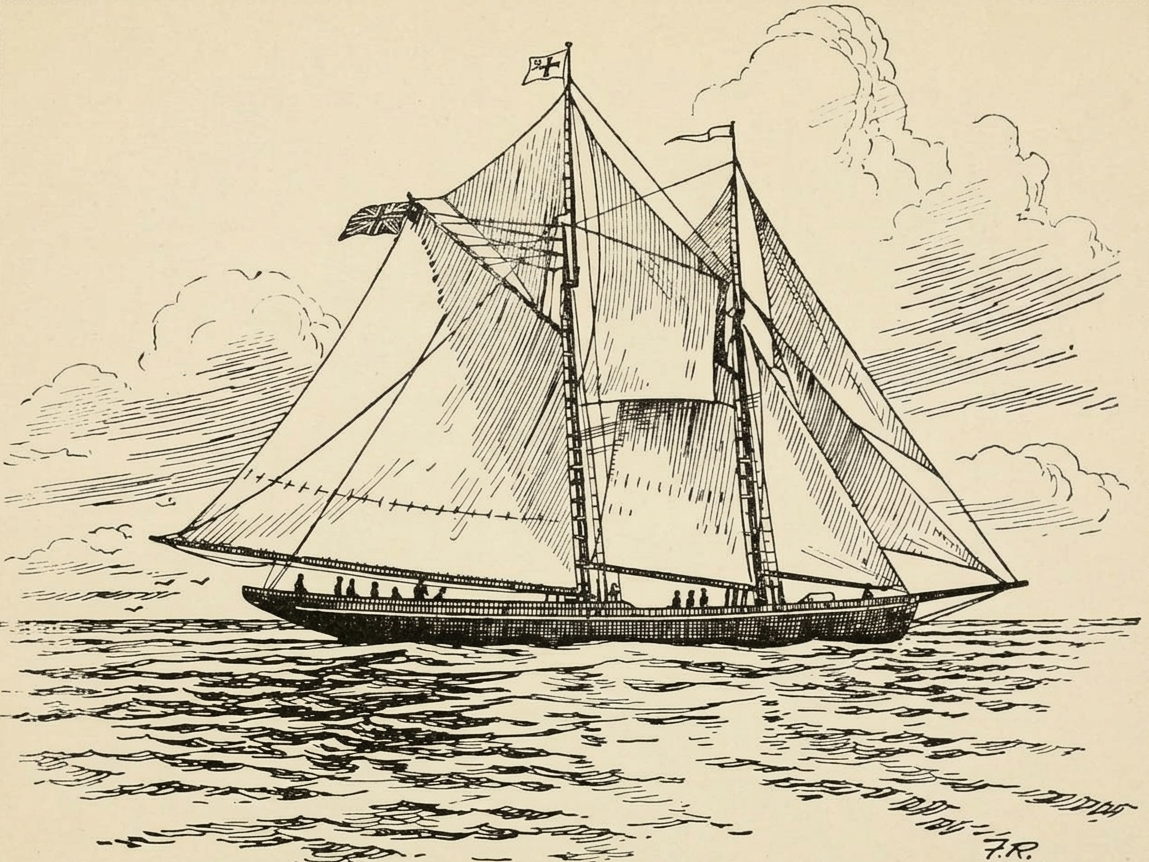
The John Knox was adrift, and our little ship was moving steadily toward the island of Tanna, where our goods would have been plundered and all of us cooked and eaten. Dr. Geddie’s boat had the John Knox in tow; and Joseph, with a crew of natives, was struggling hard with his boat to pull the Columbia and her load towards Aneityum. As God mercifully ordered it, though we had a stiff wind to pull against, we had a calm sea; yet we drifted still toward Tanna. Finally, Dr. Inglis, having heard of our arrival and going to the harbor in his boat, saw us far at sea and hastened to our rescue. All the boats now, with their willing native crews, were fastened to the schooner, and to our great joy she began to move ahead.
After pulling for hours and hours, under the scorching rays of a tropical sun, we all safely landed at Aneityum on the evening of August 30, four months and fourteen days since we sailed from Greenock. We got a hearty welcome from the missionaries’ wives, Mrs. Geddie, Mrs. Inglis, and Mrs. Mathieson, and from all our new friends, the Christian natives of Aneityum. The great danger we had together just faced and been brought through safely made us praise God all the more that He had brought us to this quiet resting place, around which lay the islands of the New Hebrides, to which our eager hearts had looked forward, and into which we entered now in the name of the Lord.
Mr. Copeland, Mrs. Paton, and I went round the island to Dr. Inglis’s station, where we were most cordially received and entertained by his dear lady and by the Christian natives there. Soon after, a meeting was called to consult about our settlement, and by the advice and with the concurrence of all, Mr. and Mrs. Mathieson from Nova Scotia were located on the south side of Tanna, at Umairarekar, and Mary and I at Port Resolution, on the same island. Because of the weak state of Mrs. Mathieson’s health, it was decided that, for a time at least, Mr. Copeland should live at either station, as might seem most suitable or most requisite.
Dr. Inglis and a number of his most energetic natives accompanied us to Umairarekar, Tanna. There we purchased a site for the mission house and church. We laid a stone foundation and began building a dwelling for Mr. and Mrs. Mathieson. From there we proceeded to Port Resolution, Tanna, and likewise purchased a site and began building the house where Mary and I would live. Lime for plastering had to be burned in kilns from the coral rocks, and thatch for roofing, made from sugar-cane leaf, had to be prepared by the natives at both stations before our return. We agreed upon a price and paid them that exact amount for the work.
Sadly, we would learn too late that both houses were too near the shore. They were exposed to unhealthy vapors leading to fevers and chills—these sicknesses are the most virulent and insidious enemy to all Europeans in those Southern Seas.
John G. Paton was a nineteenth-century Scottish missionary to the New Hebrides, where he preached the gospel to heathen cannibals for over thirty years.
