

As Paton learns the language and culture of the Tanna natives, he sees firsthand how deeply their false religion has ruined their lives. They live in constant fear of the gods, worship men who claim to have powers to influence the gods, and seek to harm others through spells and rituals. In the midst of this spiritual darkness, John and Mary Paton set out to proclaim to them the merciful God who created the world.
This is the eighth in a series of episodes from the life of John G. Paton, updated from his autobiography for young readers. Read the last episode here or the first episode here.
6 min read
The damage to the John Knox meant we had no ship fit for traveling in, so we persuaded a trader to bring us from Aneityum to Tanna. The captain kindly offered to take us and about thirty containers and crates to Port Resolution for £5. We gladly accepted! After a few hours’ sailing, we all safely landed on Tanna on November 5, 1858. Dr. Geddie went for two weeks to Umairarekar on the south side of Tanna to help Mr. and Mrs. Mathieson to settle and to make their house habitable and comfortable. Mr. Copeland, Mrs. Paton, and I were left at Port Resolution to finish building our house there and earn the favor of the natives as best we could.
At first, the natives came in crowds to look at us and at everything we did or had. We knew nothing of their language; they knew nothing of ours. We looked at them, they at us; we smiled, and nodded, and made signs to each other. That was our first meeting and parting.
One day I observed two men, one lifting up one of our articles to the other and saying, “Nungsi nari enu?”
I concluded that he was asking, “What is this?” Instantly, lifting a piece of wood, I repeated, “Nungsi nari enu?”
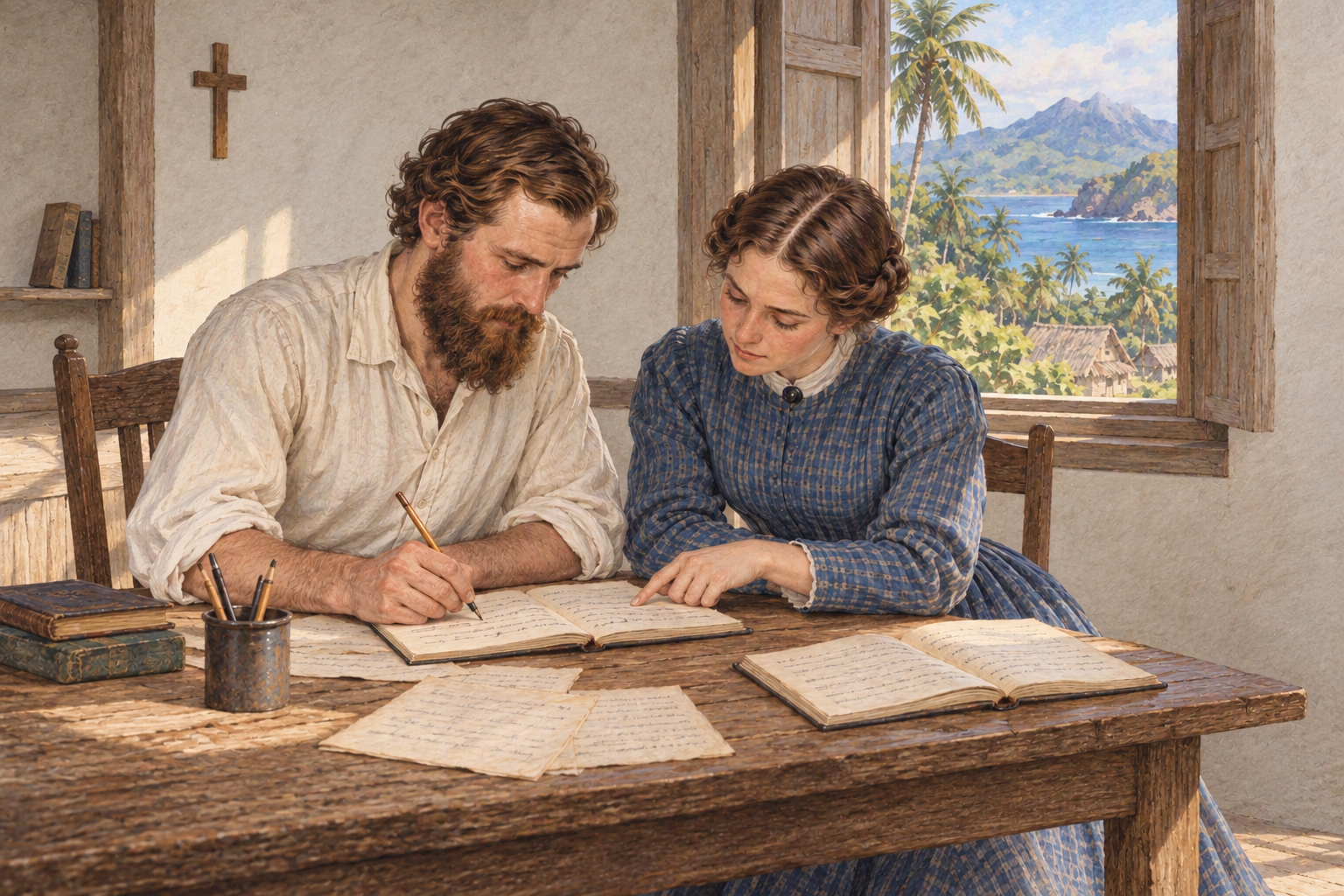
They smiled and spoke to each other. I suspected they were saying, “He’s learning our language now.” Then they told me their name for the thing which I had pointed to. I found that they understood my question, What is this? or, What is that? and that I could now get from them the name of every visible or tangible thing around us! We carefully noted down every name they gave us, spelling all by sound. We also recorded every strange sound we heard from them; thereafter, by carefully comparing different circumstances, we tried to discover their meanings, testing our own guess by again cross-questioning the natives. One day I saw two men approaching, when one, who was a stranger, pointed to me with his finger, and said, “Se nangin?”
Concluding that he was asking my name, I pointed to one of them with my finger, and looking at the other, inquired, “Se nangin?”
They smiled, and gave me their names. We were now able to get the names of persons and things, and so we learned the distinctive sounds of their language. Because we were always paying close attention, we made extraordinary progress in attempting bits of conversation and in putting their speech for the first time into a written form. At that time, the New Hebrideans had no literature, nor even the basics of an alphabet. I used to hire some of the more intelligent lads and men to sit and talk with us and answer our questions about names and sounds, but we ended up making little progress this way, for they often deceived us, and we, doubtless, often misunderstood them. But after we had learned something of their language and its construction, and after they themselves had become interested in helping us, this question-and-answer approach was more successful. Amongst our most interested and most trustworthy helpers were two older chiefs—Nowar and Nouka. In many ways, they were two of nature’s noblest gentlemen, kind at heart to all, who conducted themselves with dignity. But they were both under the leadership of the war-chief Miaki, a kind of devil-king over many villages and tribes.
The Tannese had hosts of stone idols, charms, and sacred objects, which they greatly feared, and in which they firmly believed. They were given up to countless superstitions and were firmly glued to their dark heathen practices. Their worship was entirely a service of fear, its aim being to propitiate this or that evil spirit, to prevent disaster, or to secure revenge. They revered their chiefs like gods, so that almost every village or tribe had its own sacred man, and some of them had many. These village or tribal priests had an extraordinary influence for evil and were believed to have the ability to determine life or death through their sacred ceremonies, not only in their own tribe but over all the islands. Sacred men and women, wizards and witches, received presents regularly to influence the gods. Often, this influence had the goal of either removing sickness or causing it. To cause sickness, the sacred man would cast a spell over the remains of food which the intended victim had eaten and so bring them harm. They also worshipped the spirits of dead ancestors and heroes through their idols of wood and stone. They feared these spirits and sought their help, especially seeking to propitiate those who ruled over war and peace, famine and plenty, health and sickness, destruction and prosperity, life and death. Their whole worship was one of slavish fear; they had no idea of a God of mercy or grace.
But these very facts—that they did worship something, that they believed in spirits of ancestors and heroes, and that they cherished many legends about people and things they had never seen, handing them down to their children—showed that they had ideas about the invisible world and its inhabitants. Once their language and ways of thinking were understood, these ideas made it easier than some might expect to communicate biblical truths, especially some clear idea of God as the great uncreated Father, who is spirit, and who created and sustains all that exists. But it could not be done off-hand or by a few airy lessons. The whole heart and soul and life had to be put into the enterprise. But it could be done—we believed it could be done, because they were men, not beasts. It had been done—we saw the converts on Aneityum. So with quenchless hope, our hearts rose to the task!
John G. Paton was a nineteenth-century Scottish missionary to the New Hebrides, where he preached the gospel to heathen cannibals for over thirty years.
Next in the Series
3 December 2026
The Autobiography of John G. Paton (pt. 9): At Home with Heathens
On Tanna, the natives are dominated by fear and superstition and exploited by European settlers. Every drought or storm becomes a charge against outsiders. Yet the Patons have come from among the outsiders to proclaim Jesus Christ, who alone can rescue them from their sin and darkness.
